Wake County, North Carolina
Foundation Repair for Raleigh Homes on Piedmont Clay
A crack climbing from a window corner, a bedroom door that has started to rub, a floor that slopes underfoot: these are what send Raleigh homeowners looking for foundation repair. This page sorts the signs by cause, explains the ground under Wake County houses, and lists what the usual fixes cost.
Foundation repair in Raleigh usually means sealing cracks, setting piers under a settling corner or wall, re-leveling floors, and fixing the drainage that started the trouble. Fixr's 2026 guide puts a typical project at $2,200–$8,200, about $5,200 on average. Sealing one crack can cost $200; underpinning a long wall can reach $40,000. These are national figures, not Raleigh quotes.
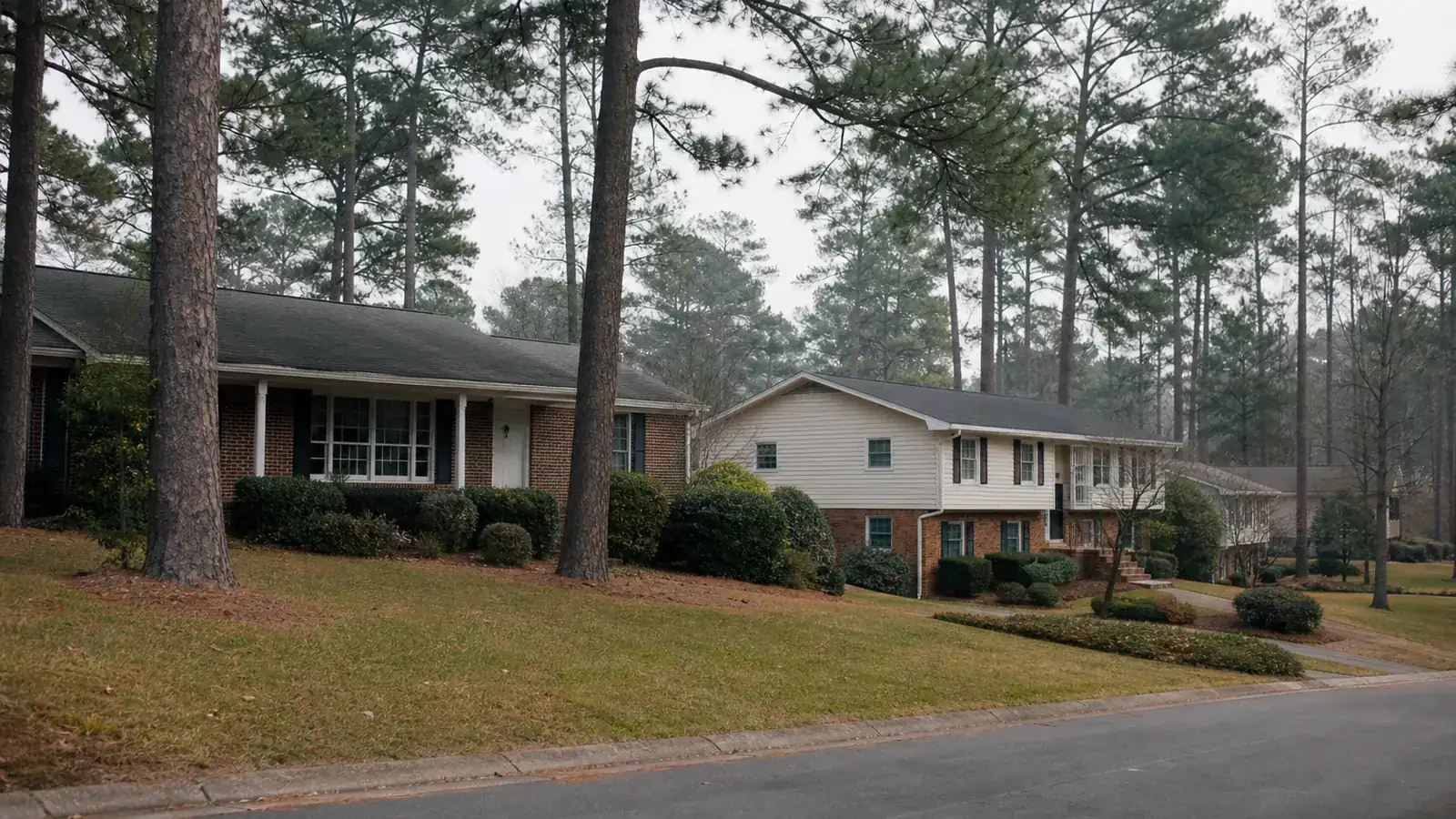
When does a Raleigh house need foundation repair?
The usual signs, roughly from least to most pressing:
- Hairline cracks in drywall or a slab that stay thin. Often shrinkage; mark the ends and date them.
- Stair-step cracks in brick veneer, or any crack wider at one end. Part of the foundation has moved more than the rest.
- Doors that rub, windows that bind, gaps opening at trim. Movement below has pulled the framing out of square.
- Floors you can feel slope, or a corner that has visibly dropped.
- Water along a basement floor or through a wall crack after storms.
The plain guide to what each warning sign means takes them one at a time.
Piedmont clay, and a band of shrink-swell ground
Raleigh sits on the Piedmont, where old rock has weathered into thick red and tan clay. In the USDA's Wake County soil survey, the most widespread natural soils are Pacolet, Cecil and Wedowee, well-drained clays that carry a house well when water is kept away from them. Even so, the survey rates about 27% of the county's rated land very limited for homes without basements, most often because of a shallow wet layer, steep slopes or clay that shrinks and swells.
That shrink-swell clay is concentrated to the west. The Deep River Triassic basin reaches into Wake County, and the NC Geological Survey names the Triassic basins as one of two areas with the state's greatest potential for expansive soil. Clays formed from its mudstone and siltstone, such as Creedmoor and Green Level, cover roughly one acre in ten of the county. The Wake County soils guide goes deeper.
Three kinds of work, one page each
- Foundation crack repairHairline, stair-step and widening cracks: which to seal, which to watch, which need more.
- House leveling and settlementSloping floors, dropped corners and sticking doors, and the piers that hold a house up.
- Basement waterproofingFinding where water gets in, then gutters and grading, drains, sumps and crack injection.
- What foundation work costs in 2026Every common repair with its published national range and the guide it came from.
Reading the house and the ground
- The clay under Wake County housesWhat the USDA soil survey and the NC Geological Survey say about building here.
- What each warning sign usually meansCracks, gaps, sticking doors, sloping floors and water, answered one at a time.
Heavy rain, a few days a year
Raleigh-Durham International Airport averages 46.07 inches of precipitation a year, and the wettest stretch runs from July through September, at 5.02, 4.71 and 5.15 inches (NOAA 1991–2020 normals). For a foundation, intensity matters as much as the total: about 11.6 days a year bring an inch or more, and four in ten of those fall in that same three-month window.
Since 2016, FEMA declarations covering Wake County have named Hurricanes Matthew, Florence, Dorian, Isaias and Ian, plus Debby and Helene in 2024. A gutter that overflows in a downpour, or a downspout that empties beside the wall, soaks the clay right where the footing rests. Fixing that is often the cheapest part of a repair.
Young houses, settling fill
Much of Raleigh's housing is recent. The city's median home was built in 1997, about 45% of homes went up in 2000 or later, and only 23% before 1980 (U.S. Census ACS 2020–2024). Newer lots are often graded with fill, and fill keeps compacting for years; about 16% of the county's mapped soil is classed by the USDA as urban land, ground already reshaped by building. Cracks in a 15-year-old house are common, and many are not serious.
Basements are the exception here. Only about 15% of North Carolina homes have one, half the national share (U.S. Energy Information Administration, 2024). Where a Raleigh home does, water at the base of the wall is the usual complaint, and the basement waterproofing page covers it.
Who calls you back, and what to check before you sign
Raleigh Foundation Solutions is an independent local resource; nobody here repairs foundations. A request goes to one independent foundation specialist who serves Raleigh and the surrounding Triangle; that person phones you and sets a time to look.
Two state rules matter. North Carolina requires a general contractor license once a project costs $40,000 or more (G.S. 87-1), and the NC Licensing Board for General Contractors runs a public license search. Separately, the state's permit exemption for smaller jobs on a house does not cover the repair or replacement of load-bearing structures (G.S. 160D-1110), so ask who will pull the permit. Get a written, itemized scope and the warranty terms on paper, then hold it up against the 2026 foundation repair price ranges.
Questions homeowners ask
How much does foundation repair cost in Raleigh?
Most jobs land between $2,200 and $8,200 in Fixr's 2026 guide; This Old House's band is $2,224 to $8,134. Small jobs cost far less: sealing one crack runs $200–$1,000. Piers are $1,000–$3,000 each, and full underpinning can reach $40,000. The Raleigh foundation cost guide lists every line with its source.
Are stair-step cracks in brick serious?
They deserve a closer look. Brick veneer is rigid, so it shows movement underneath quickly. A thin crack that keeps the same width for a year is often old settling. One that widens, reopens after patching or arrives with sticking doors suggests the foundation is still moving.
Will fixing the gutters really help a foundation?
Often more than people expect. Clay that is soaked by every storm and then dries out moves more than clay kept at steady moisture. Longer downspouts and soil graded away from the walls are usually the first changes a specialist suggests, and they cost far less than piers.
Is the first visit free?
It depends on the company. Many local specialists don't charge for the first visit; ask when they call, before they come out.
Sources
- U.S. Census Bureau, American Community Survey 2020-2024: year structure built, Raleigh city
- U.S. Energy Information Administration, Residential Energy Consumption Survey 2024: structural characteristics by state
- NOAA NCEI 1991-2020 Climate Normals, Raleigh-Durham International Airport
- NC Geological Survey: geologic hazards, including expansive (shrink-swell) clays
- N.C. Gen. Stat. 87-1, general contractor license threshold
What have you noticed around the house?
Pick the closest match and add a line about where it is and when it started. One independent foundation specialist who serves Raleigh will phone you to talk it through.